You’ve probably seen it on a slide: call a new lead within five minutes and you’re 100 times more likely to reach them, and 21 times more likely to qualify them. It shows up in sales trainings, agency pitches and software demos.
We went back to the source. The 100 is real, but it measures a drop in the odds of contact at six companies in 2007, not how much more likely you are to reach a lead.
The source
The figures come from “The InsideSales.com/MIT Lead Response Management Study.” It was first presented at a MarketingSherpa summit on October 16, 2007, by Dr. James Oldroyd and Dave Elkington, the CEO of InsideSales.com, a company that sells sales software.
| Data | Three years of calls from six companies |
|---|---|
| Leads | More than 15,000 web leads |
| Call attempts | More than 100,000 |
| Channel | Phone only |
| What counted as a contact | A live call of a set length, defined by each company |
| What counted as qualified | Defined by each company |
| What it reported | Changes in the odds of contact and qualification |
| Peer reviewed | No |
Here’s the line everyone borrows: “The odds of contacting a lead if called in 5 minutes versus 30 minutes drop 100 times.” For qualifying a lead, the odds “drop 21 times.”
Three things the slide version gets wrong
1. Odds aren’t “times more likely”
Odds compare the calls that connect with the calls that don’t. A chance compares the calls that connect with all the calls. When connecting is common, the two numbers move very differently.
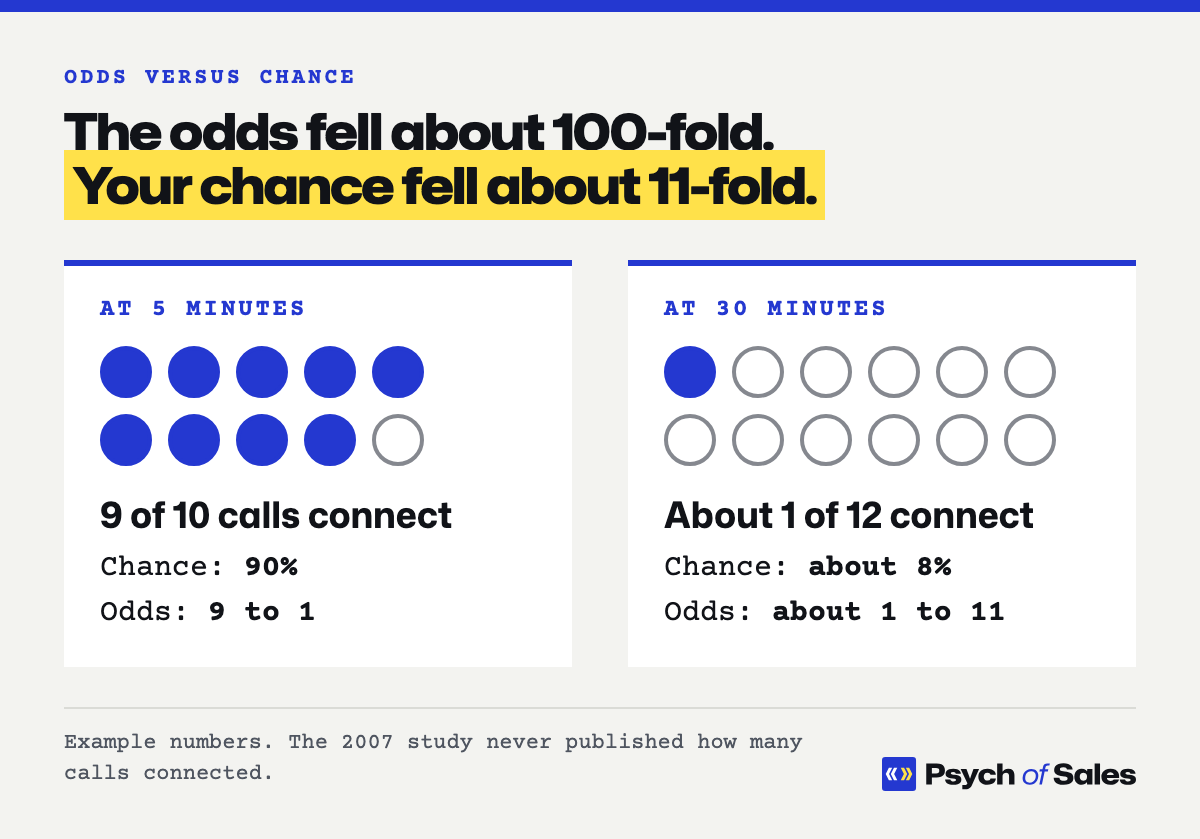
| At 5 minutes | At 30 minutes | Change | |
|---|---|---|---|
| Calls that connect | 9 in 10 | About 1 in 12 | |
| Chance of connecting | 90% | About 8% | About 11 times lower |
| Odds of connecting | 9 to 1 | About 1 to 11 | About 100 times lower |
So nobody can turn the study’s 100 into “100 times more likely.” The two numbers only come close when few calls connect even at five minutes.
2. The company’s own blog told a different story
On November 26, 2007, the company’s blog described the same comparison as “10 times more likely to contact a lead, and 6 times more likely to qualify a lead than by waiting even 30 minutes.” The study’s write-up uses 10 and 6 for something else: how much the odds fall across the whole first hour.
3. Six companies, phone only, 2007
The companies aren’t named, the data isn’t public and the study wasn’t peer reviewed. It was co-presented by the CEO of a company that sells the fix. None of that makes it wrong, but it’s thin support for a precise number everyone repeats.
What holds up
The direction does. In March 2011, Harvard Business Review published “The Short Life of Online Sales Leads” by James Oldroyd, Kristina McElheran and David Elkington. It reported two separate findings.
The first was an audit: the authors sent a web lead to 2,241 U.S. companies and timed each reply.
How 2,241 U.S. companies replied to a web lead
| Reply time | Companies |
|---|---|
| Within an hour | 37% |
| 1 to 24 hours | 16% |
| More than 24 hours | 24% |
| Never replied | 23% |
The second was a separate study of 1.25 million leads received by 42 U.S. companies. Firms that tried to contact a lead within an hour were “nearly seven times as likely to qualify the lead,” which the authors defined as “having a meaningful conversation with a key decision maker,” as firms that tried “even an hour later.”
Two caveats. Elkington ran the same software company, and the article doesn’t say how the seven-times comparison was made. Nothing suggests a controlled test, so the faster firms may have differed in other ways too.
What to do with your own numbers
The direction is real: the sooner someone reaches a new lead, the better the chance of a real conversation. The exact multiplier isn’t worth putting on a slide. Your own reply times are worth counting.
For two weeks:
- Log every call and web form that comes in, and how long until someone replied.
- Mark which ones turned into a quote or a job.
- Compare the fast replies with the slow ones.
| Came in | Channel | First reply | Minutes | Quote or job? |
|---|---|---|---|---|
| Mon 9:12 am | Call | 9:14 am | 2 | Yes |
| Mon 1:47 pm | Form | 4:05 pm | 138 | No |
| Tue 6:30 pm | Call | Missed | missed | No |
| Wed 8:03 am | Text | 8:20 am | 17 | Yes |
| Thu 11:55 am | Form | Fri 9:10 am | 1,275 | No |
| Sat 10:20 am | Call | Missed | missed | No |
Want it measured for you?
The Secret Shopper Sales Audit makes 12 test contacts over two weeks (calls, web forms, and texts or chats) and times how fast each one got a first reply. That’s your speed to lead, measured.
Sources
- “The InsideSales.com/MIT Lead Response Management Study,” write-up of the October 16, 2007 presentation, as archived August 20, 2008: https://web.archive.org/web/20080820044837/http://www.leadresponsemanagement.com/mit_study.html
- InsideSales.com, “What is Lead Response Management?”, November 26, 2007: https://www.insidesales.com/?p=5429
- Oldroyd, J. B., McElheran, K., and Elkington, D. (2011). “The Short Life of Online Sales Leads.” Harvard Business Review, 89(3): https://hbr.org/2011/03/the-short-life-of-online-sales-leads
- Barrett, S. (2011, July 1). “Are you letting online leads go cold?” SmartCompany, a free summary that quotes the article’s findings: https://www.smartcompany.com.au/marketing/20110704-are-you-letting-online-leads-go-cold/